Billboard (magazine)

Billboard · Public domain
Billboard is a Manhattan-based multinational music and entertainment magazine published weekly by Penske Media Corporation.
- founders
- William H. Donaldson and James H. Hennegan
Reader's Guide
Billboard's significance lies in its role as a central arbiter of commercial music success through its charts, which rank singles and albums based on sales, streaming, and radio airplay. The magazine also hosts events, owns a publishing firm, and operates television shows, extending its influence beyond print. By the 1990s, it was widely regarded as the 'bible' of the recording industry. Its evolution from a bill-posting trade paper to a multimedia music authority reflects broader changes in entertainment and technology, including the rise of jukeboxes, phonographs, and radio. Despite ownership changes, Billboard has maintained its position as a key source of music news, charts, and analysis for over a century.
Did You Know?
- Billboard was originally named Billboard Advertising and was only eight pages long in its first issues.
- In 1920, founder William H. Donaldson hired black journalist James Albert Jackson to write a weekly column on black performers, the first black critic at a national magazine with a predominantly white audience.
From Bill Posters to a Cultural Institution
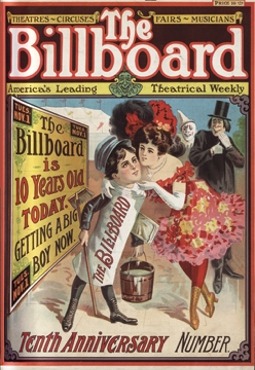
At the time, public-facing advertising—billboards, posters, and paper notices—was the dominant way businesses reached audiences, and the magazine served as a trade paper for the people who plastered those advertisements across cities. Donaldson managed editorial and ad sales while Hennegan, through his printing company, oversaw production. The early issues featured quirky columns like The Bill Room Gossip and even a department devoted to agricultural fairs by 1896. He immediately shifted it from a monthly to a weekly format, opened bureaus in New York, Chicago, San Francisco, London, and Paris, and redirected the masthead toward the booming world of outdoor entertainment: circuses, carnivals, vaudeville, and burlesque.
The Mail-Forwarding Service That Bound an Industry Together
As rail networks expanded across the country in the early 1900s, traveling performers found themselves perpetually on the move, making it nearly impossible to receive personal mail. The system worked through two recurring columns: Routes Ahead tracked where each entertainer was heading next, and the Letter-Box column announced when mail had arrived for a particular star. Beyond its commercial value, the mail system cemented Billboard's role as a connective tissue in the entertainment world, giving the magazine direct, ongoing relationships with performers and making it an indispensable institutional presence long before it became synonymous with music charts.
How Technology Forged the Music-Chart Monopoly
Billboard's transformation from a general entertainment trade paper into the definitive music-industry authority was driven largely by technological shifts. The jukebox industry boomed even through the Great Depression, and heavy advertising in Billboard further pulled the masthead toward recorded music. The phonograph and wireless radio added to this momentum.
Breaking Racial Barriers and a Century of Ownership
In 1920, publisher William Donaldson made a controversial but landmark decision: he hired James Albert Jackson, a Black journalist, to write a weekly column devoted to Black performers. Jackson became the first Black critic at a national magazine with a predominantly white readership. His column exposed the discrimination Black artists faced and helped legitimize their careers in the eyes of a broader industry. According to his grandson, Donaldson also instituted a policy against identifying performers by their race—a progressive stance for the era. Since then, Billboard has passed through various corporate hands, ultimately landing under Penske Media Corporation, which now operates it as a Manhattan-based multinational publishing group. The company's portfolio extends well beyond the weekly magazine, encompassing music charts, news, video, opinion, reviews, events, a publishing firm, and several television shows, cementing Billboard's role as a multimedia entertainment institution.
Gallery



Frequently Asked Questions
Why is Billboard considered important in the music industry?
Its charts and coverage have shaped how artists, labels, and the public measure commercial success for well over a century. A number-one spot on one of its lists remains one of the most coveted achievements in the music world.
More in Magazines 1-19
Spotted an error? Know more?
This is a living reference — every entry is fact-audited, and reader corrections feed straight into our audit queue. Suggest an edit · See this site's audit record